
Finding the Missing: Private Investigator Services in Florida
· Roberts Investigative Services
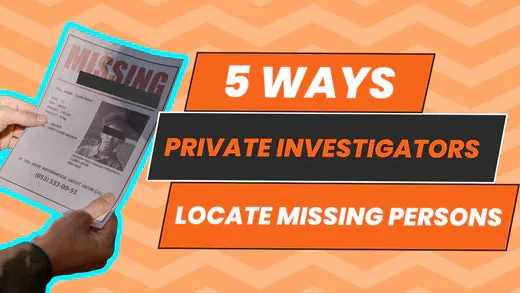
The Emotional Toll of a Missing Loved One
When safety may be at risk, contact law enforcement first. You do not need to wait 24 hours to report someone missing. A private investigator may work alongside an official search or take on lawful work outside law enforcement priorities.
The Reality of the Search
The search starts by confirming the last reliable contact and separating known facts from repeated assumptions. That foundation determines whether records, interviews or field verification should come next.
Skip Tracing & Legal
Locate witnesses, parties or debtors for a legitimate legal purpose using records research and field verification where necessary.
Family & Missing Persons
Develop and verify leads involving a runaway minor or missing relative. A competent adult may choose not to reconnect, and a located person's private address is not disclosed automatically.
A Multi-Layered Approach to Locating Subjects
A successful locate requires more than just a Google search. We combine boots-on-the-ground surveillance with high-level data access.
Digital Footprints & Records
Public posts, known usernames, address history, property records, court records and other lawful sources may develop leads. We do not access private email, Social Security records or protected accounts without consent or legal authority.
Surveillance & Collaboration
Once a likely location is developed, it may require field verification. The method depends on safety, privacy and lawful purpose; a database match alone is not treated as confirmation.
The first hours
If the person is a minor, has a medical or cognitive condition, or there is any reason to think they are in danger, the first call is law enforcement. There is no 24-hour waiting period in Florida, and any agency telling a family to wait should be asked to take the report anyway. For a missing child, the National Center for Missing & Exploited Children can be reached at 1-800-843-5678.
While the report is being taken, preserve what will otherwise disappear:
- Note the exact time the person was last seen and by whom, before recollections merge.
- Do not tidy their room, wash clothing or clear devices.
- Write down the vehicle, plate, phone number, and what they were wearing.
- Identify which neighbours or businesses have cameras facing the route — and ask them the same day, because most systems overwrite within a week.
- Keep a single written log of every call, sighting and rumour, with times and sources.
That log is the most valuable thing a family produces. It is also the thing most often reconstructed from memory weeks later, at which point it is unreliable.
What an investigator adds alongside an official search
Law enforcement prioritises by risk, and correctly so. A case involving a competent adult who left voluntarily will sit low on that list — which is exactly where private work is most useful, because it is lawful, unhurried and not competing for a detective's caseload.
An investigator can pursue address history, associates, employment and property records, verify a database lead in the field before a family drives four hours on it, canvass an area methodically, and interview people who will speak to a private party but not to police.
Client Advisory: The "Small Details" Matter
Bring exact names and spellings, date of birth, dates, photographs taken recently rather than the most flattering one, known usernames, vehicles, addresses going back several years, associates, and the timeline. Label second-hand information clearly so it is not mistaken for a confirmed fact — a rumour repeated three times is still one rumour.
When the answer is one a family did not want
A competent adult is entitled to be left alone. Where someone is located and does not wish to be contacted, the investigation can confirm that they are alive and not under duress, and stop there. A located person's address is not disclosed automatically, and a report that says "found, safe, declines contact" is a complete and successful result even when it is a painful one.
We do not guarantee that a person will be found, and no one honestly can.
Frequently Asked Questions
What records can a Private Investigator access?
Is it legal to use GPS trackers?
Decide the Right First Call
Serving Florida and St. Lucie County.
Call for a Free Consultation: +1-888-772-7894
If this is where you are right now, we can help with our missing persons work, skip tracing techniques and Okeechobee County.
Private · No Obligation
Find out whether an investigation can help.
Describe the question you need answered. A licensed investigator will explain what can be done legally, what information would help and what the likely scope will be.